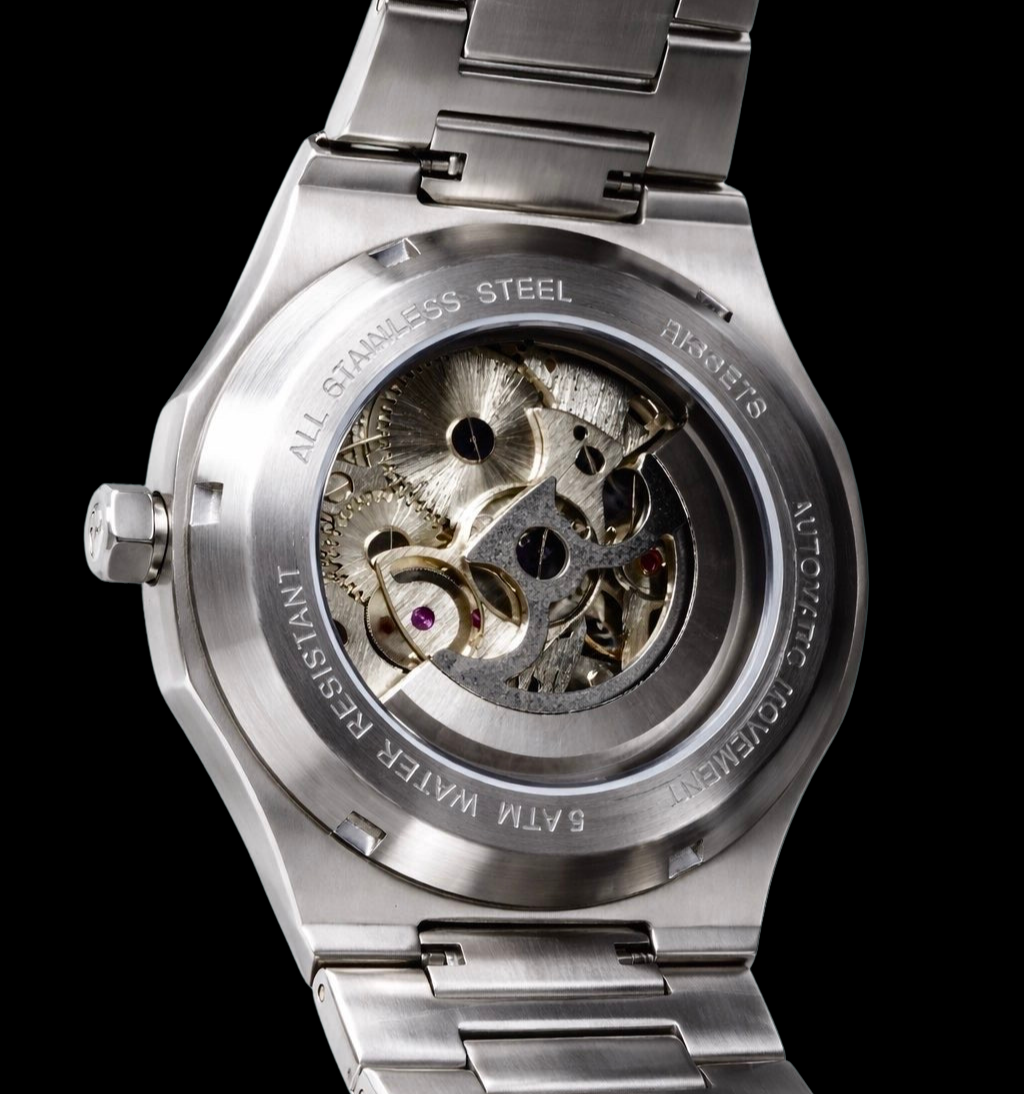
There is a reason silver-toned watches have never gone out of fashion. While trends push gold in and out of favour and dark coatings come and go, stainless steel quietly endures. It is the neutral that works with everything — and when that steel is paired with an open, skeletonised dial, the result is a watch that feels both timeless and quietly modern.
A silver skeleton watch sits at the intersection of restraint and intrigue. The cool metal tone keeps things understated on the wrist, while the exposed movement gives the eye something to discover. It is a combination that flatters every skin tone, every wardrobe and very nearly every occasion.
The Case for Neutral Versatility
Colour theory does much of the heavy lifting here. Silver and steel are achromatic — they carry no warm or cool bias of their own, which means they refuse to clash. Gold tones can fight with cooler outfits and certain complexions; rose tones lean romantic and casual. Silver simply adapts.
That neutrality is precisely why a stainless steel skeleton watch is the most forgiving choice you can make. It does not demand that the rest of your look be built around it. Instead, it slots in beside whatever you are already wearing, lending polish without drawing the whole outfit off course.
How Steel Pairs With Any Outfit
The genius of steel is its breadth. The same watch reads as crisp and professional against a white cuff, then turns relaxed and easy against a knit or a t-shirt. Few accessories cover that much ground.
| Outfit | How the Silver Skeleton Reads |
|---|---|
| Navy or charcoal suit | Sharp and discreet — the steel echoes the cool tones without competing |
| White shirt, no tie | Clean and confident; the open dial adds quiet interest |
| Knitwear and denim | Relaxed but considered, an easy weekend signature |
| All-black evening wear | Crisp contrast; the silver catches light where gold would feel heavy |
| Earth tones and tan leather | A cool counterpoint that stops the palette feeling flat |
Because steel is so reflective, it also plays well with mixed metals — a notion that once felt like a styling sin but now reads as deliberate. A silver watch sits comfortably alongside both white-gold and yellow-gold jewellery, bridging the two rather than picking a side.
The Skeleton Difference
A skeleton dial earns its keep by adding depth without adding noise. Stripping back the dial reveals the mechanical heart of the watch — the bridges, the barrel, the steady sweep of the balance. It is detail you only notice up close, which is exactly the point: understated from across the room, fascinating in the hand.
That mechanical openness has a long and serious heritage. The craft of building precise mechanical movements traces back centuries; the Royal Museums Greenwich tells the story of John Harrison’s marine timekeepers, the eighteenth-century clocks whose engineering laid the groundwork for the precision wristwatches we wear today. A skeleton dial is, in a small way, a tribute to that lineage — putting the machinery on display rather than hiding it away.
Styling Across Occasions
The real argument for silver is consistency. You can wear one watch from a morning meeting to a dinner reservation without a second thought. It does not skew too formal for the weekend or too casual for the office. It simply works, in the way that good neutrals always do.
If you are building a collection from a single, do-everything piece, a versatile silver skeleton like the Senza makes a strong opening move. One watch, every wrist, every occasion — which is rather the whole point.
The Bottom Line
Silver suits everyone because it asks for nothing. It does not impose a mood or tie itself to a season. Add a skeleton dial and you keep all that easy versatility while gaining a layer of quiet character. For a watch you can wear with anything and grow tired of nothing, steel and an open dial remain the most reliable pairing there is.