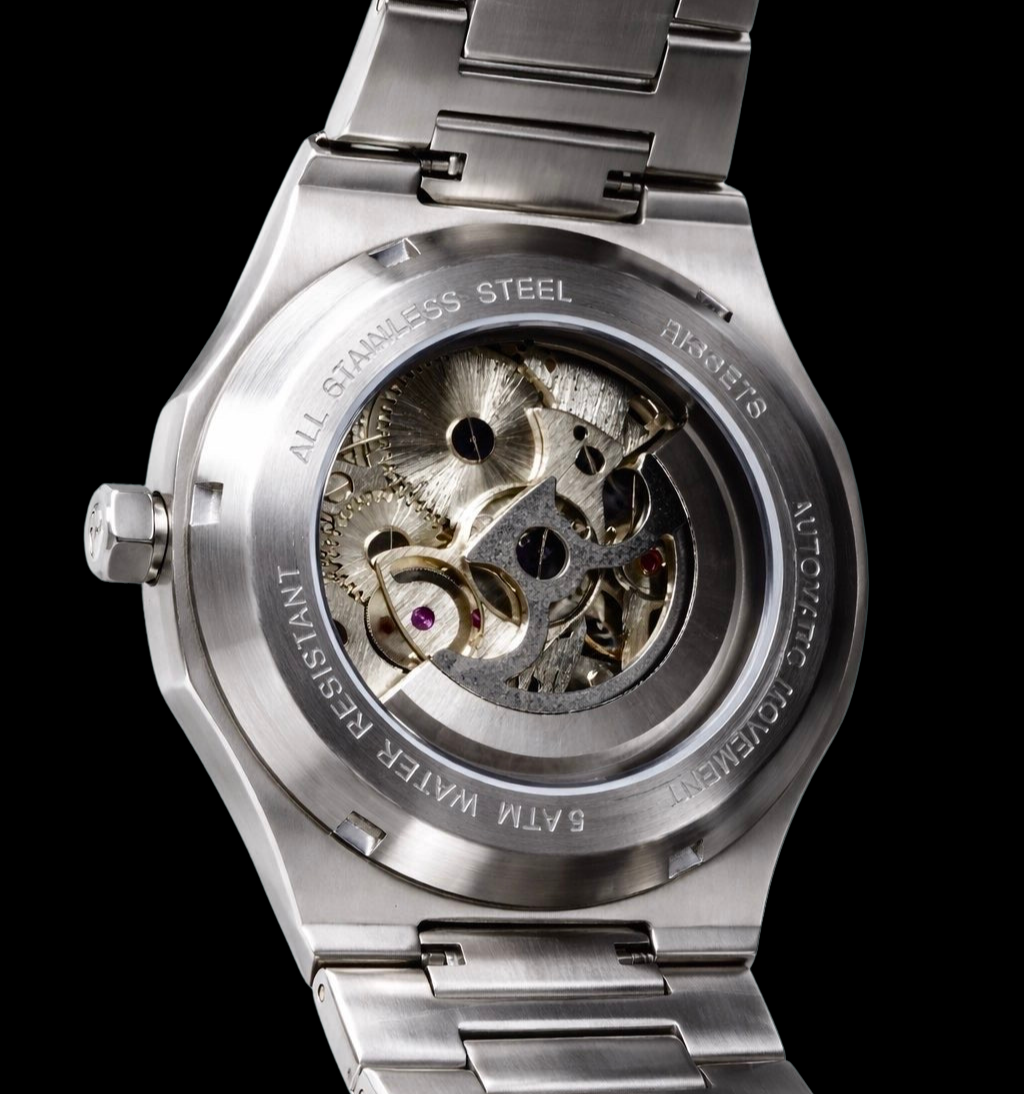
Most watches hide their genius. A sealed dial sits over the mechanism, and the only thing you ever see is the time. A skeleton watch does the opposite. It strips away the surface and puts the moving heart of the watch on display, turning the dial itself into a window onto the engineering beneath.
For mechanically curious wearers, that openness is the entire appeal. You are not just reading the hour, you are watching it being kept. This guide explains how an automatic skeleton movement actually works, what the exposed components reveal, and why the open-dial watch has earned a loyal following among men who like to understand what sits on their wrist.
What “skeleton” actually means
A skeleton watch is one where the movement has been deliberately exposed, either by cutting away the dial, the mainplate and bridges, or both. Rather than a solid face printed with markers, you get an open architecture that reveals the gears, springs and bridges working in real time.
There are two ideas worth separating:
- Open-dial (open-heart): Only part of the dial is cut away, usually a small aperture revealing the balance wheel or escapement.
- Fully skeletonised: The dial is removed almost entirely, and the movement’s own plates are hollowed out so light passes straight through the watch.
A true men’s automatic skeleton watch leans toward the second category, exposing as much of the mechanism as structural integrity allows while keeping the timekeeping accurate.
How an automatic skeleton movement works
The word “automatic” describes how the watch is powered. Where a manual watch needs winding by hand and a quartz watch runs on a battery, an automatic winds itself from the motion of your wrist. Walk, gesture, type, and a weighted rotor spins, gradually tightening the mainspring that stores the watch’s energy.
In a sealed watch all of this happens out of sight. In a skeleton, you can follow the whole chain of events:
- The rotor swings as your wrist moves and winds the mainspring.
- The mainspring, coiled inside the barrel, stores that energy.
- The gear train transmits the energy in controlled steps toward the hands.
- The escapement and balance wheel release that energy in precise, even beats, which is the steady tick that keeps time honest.
Watching an automatic skeleton movement run is the closest most people get to seeing mechanical time as a living process rather than a number.
What the exposed parts reveal
The pleasure of an open dial is recognising the components and understanding their role. Here is what you are typically looking at:
| Component | What it does | Why it matters on a skeleton |
|---|---|---|
| Mainspring barrel | Stores wound energy and releases it gradually | Often left visible so you can see the power source itself |
| Bridges | Metal supports that hold the gears and wheels in place | The “skeleton” structure; their finishing defines the watch’s character |
| Gear train | Transfers energy from barrel to escapement | Shows the geometry of how power moves through the watch |
| Balance wheel | Oscillates back and forth to regulate timekeeping | The most hypnotic part to watch, beating several times per second |
| Escapement | Releases energy in measured steps | The source of the audible tick and the watch’s accuracy |
| Jewels (rubies) | Reduce friction at high-wear pivot points | Visible flecks of colour that hint at the movement’s quality |
The bridges deserve a special mention. On a sealed watch they are purely functional and hidden, but on a skeleton they become the watch’s visual signature. Their shape, brushing, polishing and chamfering are what separate an ordinary mechanism from one that reads as a piece of design. This is also where the heritage of fine watchmaking shows; the discipline of finishing and regulating a mechanical movement is a craft with centuries of history, well documented by institutions such as Royal Museums Greenwich in their account of Britain’s pioneering precision timekeepers.
Why it appeals to mechanically curious wearers
A skeleton watch rewards attention. A sealed watch tells you the time and stops there; an open dial invites you to keep looking. There is a quiet satisfaction in glancing down mid-meeting and seeing the balance wheel still beating, the rotor catching the light as you move.
Three things tend to win people over:
- Transparency builds appreciation. Once you can see the mechanism, you understand why a mechanical watch is an achievement rather than a commodity.
- It is a conversation piece. Few objects you wear daily are this openly engineered, and people notice.
- It connects you to craft. Every visible bridge and jewel is the result of deliberate hand-finishing, which is hard to fake and easy to admire. It is this quality that defines a well-made open-dial watch.
Living with an open-dial watch
A skeleton watch is not fragile, but a few habits keep it at its best. Wear it regularly so the automatic winding keeps it running; an automatic that sits idle for a day or two will simply stop and need a gentle restart. Keep it away from strong magnetic fields, which can affect accuracy, and have the movement serviced periodically so the lubricants and finishing stay in good order.
Beyond that, the maintenance is mostly enjoyment. The more you wear it, the more you notice, and the open dial that drew you in at first becomes a small daily reminder of the engineering you have chosen to carry around.
The short version
A men’s automatic skeleton watch is a mechanical watch that powers itself from your movement and shows you exactly how it does so. The exposed mainspring, bridges, gear train and balance wheel turn timekeeping into something you can watch rather than merely read, and for anyone drawn to how things work, that openness is the whole point.