There is a particular kind of confidence required to make a single watch. Not a collection. Not a range. One watch — refined until it is exactly right. That is the principle at the heart of Bisset Watches, a British watch brand that has chosen depth over breadth, and craftsmanship over convenience.
The watch in question is the Senza. And its defining feature — the one that draws the eye and holds it — is the skeleton dial.
Why Skeletonisation?
To understand the skeleton dial, you first have to understand what it represents. Skeletonisation is the art of removing all non-essential material from a watch movement, leaving only the bridges, gears, springs, and jewels necessary to keep time. The result is a dial that does not simply display the time — it reveals how the time is made.
It is one of the most labour-intensive finishing techniques in watchmaking. Each component must be individually shaped, bevelled, and polished to a standard that would otherwise remain hidden from view. When a watchmaker commits to a skeleton movement, they are committing to a standard of finish across the entire mechanism — not just the parts a customer sees.
For Bisset, this was never a decorative decision. It was a philosophical one.
The Design: Octagonal, Considered, Deliberate
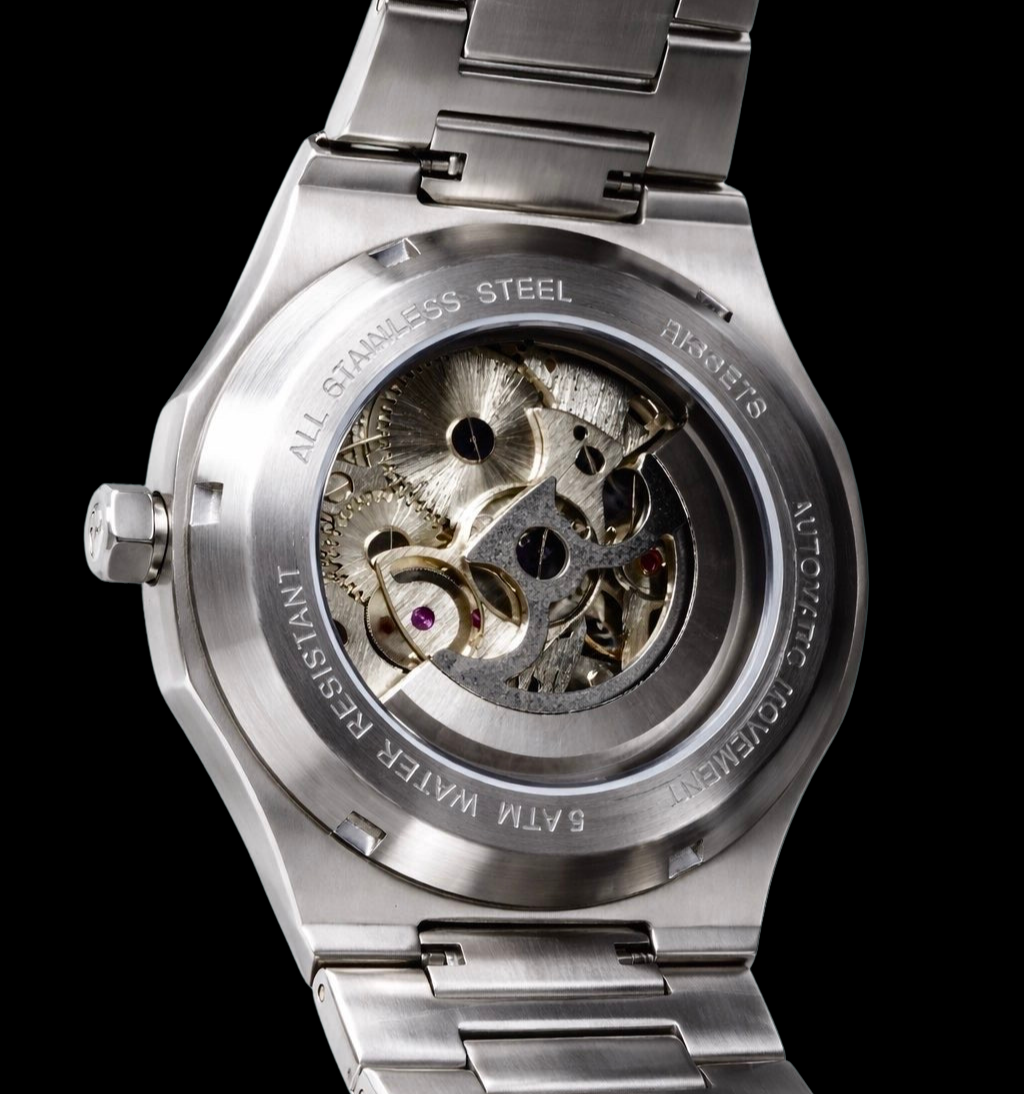
The case that houses the Senza movement is octagonal — an eight-sided form with chamfered edges and a brushed stainless steel finish that catches light at every angle. The shape is immediately distinctive without being ostentatious. It references the geometry of classic dress watches while standing apart from the round case majority.
The decision to combine an octagonal case with a skeleton dial was not incidental. Both choices share the same logic: they make visible what is usually concealed. The case geometry exposes structure through form; the dial exposes structure through transparency.
Below the dial, the movement comes into full view — a fully automatic calibre with a gold mainspring barrel, ruby jewels, and silver bridges arranged with the kind of considered symmetry that only becomes apparent when there is nowhere to hide.
| Watch Feature | Detail |
|---|---|
| Case Shape | Octagonal, chamfered edges |
| Case Material | Brushed stainless steel |
| Dial Type | Fully skeletonised |
| Movement | Automatic |
| Mainspring Barrel | Gold finish |
| Jewels | Ruby |
| Bridges | Silver finish |
| Hour Markers | Baton indices |
| Chapter Ring | Black |
| Bracelet | Integrated three-link brushed steel |
The chapter ring is black, providing enough contrast for the baton hour markers to read cleanly against the complexity of the movement beneath. The name BISSETS appears on the dial — the one deliberate mark of identity on an otherwise open canvas.
A British Brand With a Clear Point of View
The history of Bisset Watches is rooted in a conviction that British watchmaking need not be defined by heritage alone. It can be defined by intention.
Where many brands in the accessible luxury segment opt for legibility at the expense of interest, Bisset made the opposite choice. The Senza is not a watch that reveals everything immediately. It rewards attention. The longer you look, the more you see — the motion of the rotor, the interplay of light on the bridges, the engineering made visible through the absence of material.
This is quiet luxury in its truest expression: not the absence of detail, but the presence of restraint.
The Founders’ Philosophy
The founders of Bisset Watches approached the brief with a single-minded focus: to produce one watch that could stand alongside far more expensive pieces not through marketing, but through merit.
That meant specifying a movement worthy of display. It meant selecting a case architecture that justified the skeleton treatment — the octagonal form giving structure and framing to the exposed mechanism below. And it meant resisting the instinct to add when the correct response was to subtract.
The skeleton dial is the fullest expression of that instinct. It is a dial that says: look closer. There is more here than you first thought.
Craftsmanship, Properly Understood
The Bisset Senza occupies a considered position in the watch market — a piece that delivers the visual and mechanical complexity of movements found in watches at several times the price, without the name recognition premium that typically accompanies them.
The integrated bracelet continues the design coherence of the case, the three-link brushed steel construction flowing from the lugs with a continuity that makes the watch feel like a single resolved object rather than a collection of components.
The Royal Museums Greenwich’s H4 marine timekeeper — John Harrison’s prize-winning longitude watch, completed in 1759 — stands as perhaps the most consequential small watch ever made. Its legacy is precision: the idea that a watch movement could be so finely engineered as to change history. The Senza draws on that same tradition — not in function, but in spirit. A watch that takes its internal engineering seriously enough to put it on display.
One Watch, Properly Made
The skeleton dial is not a trend. It is a commitment. It commits the watchmaker to a standard of finishing that covers every surface of the movement. It commits the brand to a level of transparency — quite literally — that most choose to avoid.
Bisset Watches made that commitment with the Senza. The result is a watch that earns its complexity: where every removed layer of material adds to the story rather than diminishing it.
That, in the end, is what good design does. It makes the intention legible.